
IDRISTAN
by
Nick Weldon
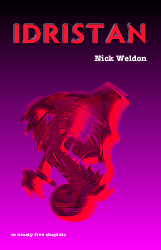
ISBN no: 9780956112903
In paperback from The Jazz Shop
In paperback and ebook from Amazon
Comic, moving, sexy, poetic and philosophical, Idristan is a novel about jazz, love, squash and our experience of time.
Meet some of the characters:
Myfanwy Muff Maboob, muse of Idristan
Spiff Abrahams, cutting edge musician
Cornelius Brewster, anglophile
The Royal Family, jazz hounds
Here are a pair of chaplets from the novel...
Chaplet 7
Old Bones
Myfanwy followed the two men down the service corridor and into a cupboard. Narrow stone stairs led down into the darkness; Myfanwy could hear the men chatting as they descended below her. She took off her clackety high-heeled shoes and padded down after them.
"Well, Principal, I'm intrigued. I never knew any of this existed. Where are we going, exactly?"
"This web of stairs and tunnels has been in existence for hundreds of years. It is our private route to the Palace."
"To the Palace?!" exclaimed Spiff. "You mean?...Is that where we are going now?"
"Yes indeed, my boy", replied Cornelius Brewster, portentously. "Finally you have been called. In this hour, if you only conduct yourself well, you will receive the blessing of your Sovereign."
Myfanwy heard a curse followed by a rattling noise as objects scattered across the stone.
"Bloody Taffs!" shouted Cornelius. The men were no longer moving, and Myfanwy crept round a succession of corners until she could hear the Principal's murmured explanation.
"All this, stairs, tunnels, passages, the whole caboodle, is the work of the Welsh miners. Oh, back in the 1300s, I should imagine. When the Welsh were so Welsh they were almost Jewish. They were given the Royal Decree for their pathetic little Music School in return, but it wasn't enough. They wanted Palace Rights, like the rest of us, and Guild Membership, yes and all the High Teas and Holidays. That was never going to happen. They were only ever a bunch of burrowers, after all. But there was a hunger strike, and an ugly confrontation here in the passageways, and the miners perished. Here, below ground, in their finest digging! The bones are everywhere. Bloody Taffs!"
Myfanwy trembled all over to hear the fate of her ancestors so coldly described. She vomited quietly into one of her shoes. The men were on the move again. In passing, Myfanwy swiftly gathered together the bones of her forebear and fashioned them into the semblance of a human shape. On an impulse she then removed a femur from the skeleton and tucked it inside her neat shiny red leather handbag.
Suddenly, with her hand round the human bone, Myfanwy lost all desire to carry on with the mission she had agreed to, and which was now starting to feel dangerous. She wanted to be at home, in her cosy little caravan in Chigwell.
"Let them have their stupid meeting", she told herself defiantly. Then she heard footsteps above her, two sets, coming in her direction. One set, she surmised, belonged to the short Asian woman who followed Spiff everywhere, the other, heavier, more deliberate, and further back, to Victor, the brutal and intimidating Nigerian Head of Security.
Muff knew she had no choice but to continue her descent. In front of her, Cornelius was dispensing advice.
"Above all, old boy", said the Principal, "keep banging on about Englishness. And don't mention the Welsh at all, if you can help it. They have some sort of weird obsession with the Welsh, especially the Nutter Prince. They will speak Welsh among themselves, you'll notice, even though they'll address us in English. Just pretend you think it's normal! You won't be on your own, anyway."
As he spoke he indicated the small groups of people who were now joining them in the great stone passageway leading underground to the heart of Buckingham Palace.
Spiff recognised Principals and Heads of Jazz from the other Royal Music Colleges of the City. He suddenly visualized the cutting contest to come, and saw his exhausted competitors lay down their instruments while he completed his marathon solo serenade of the Sovereign; with this beautiful thought his penis, symbol of his self-belief, twitched into life and uncurled, warm and throbbing along his inner thigh.
Chaplet 8
The Baptism
Spiff held forth about his vision while the Queen poured tea.
"My new department is completely cutting edge. We have devised a new fusion music that combines the very best of the old bebop with the best of the new hiphop, but with an unmistakeable stamp of Englishness. We call it Bip-Bop, Ma'am."
Cornelius Brewster nodded approvingly. The Prince was munching some ginger cake.
"Sort of hey nonny nonny John Coltrane. What a splendid idea." His tone was playful. He began to sing in a lovely bass baritone.
"On yonder hill there stands a jazzman. Who he is I do not know. Will he ever end his solo? Is the answer yes or no?"
He gestured around him, and the Queen, King, and various little Royal people, all joined in for the chorus,
"Oh no John, no John, no John, no!"
Spiff blushed, sensing he had been the butt of a joke that
he didn't quite understand. He picked up his horn and began to play, determined to reestablish his creative credentials. The other Heads of Jazz joined him and soon the cutting contest was under way.
The Royal Hosts chattered continuously among themselves during the performance, but it was only during the bass solo that Myfanwy could make out their words from her hiding place behind the immense heavy red curtains in the corner of the hall. To her astonishment they were speaking in Welsh.
"Who are these lame tossers?", said the Queen.
"They couldn't swing from the gallows!", said her husband.
"How they could take the joy of Louis Armstrong, the fire of Ornette Coleman, the passion of John Coltrane, the humour of Roland Kirk...." said the Queen,
"...and turn it into this anodyne pap!", continued her husband.
"This one scale per chord stuff is doing my pretty little head in", said one of the Royal nieces.
The Prince's glorious bass baritone cut in with authority, sending a shiver of sexual allegiance jolting through Muff's body.
"It's only what they've done with the country", he said.
"Now don't start that again, dear", said his mother, "you'll only get over excited and be sick."
"N'empêche, chère maman", replied the Nutter Prince, "they despoil the memory of the Ancient Briton, whose blood courses through our veins; their notion of English Heritage is fake and lame, with as much true history about it as the Great English Ploughman's Lunch! It is a monstrous deceit, foisted upon a gullible populace to ensure their continued complaisance, and to bleed them dry of their money, and of
their true birthright."
The bass solo transmogrified into a loud drum solo; the Prince continued his declamation in time with the drums.
"Yet we are the Ancient Britons; we have never gone away, and one day we will rise again and lead our people from the dark tunnels of English Heritage into the light of Idristan!"
Muff was nearly fainting with excitement. Never had she imagined that she would hear her destiny in this place and in this way.
The drums subsided and the horns took up their bleating refrain again; Spiff, aiming for late Coltrane sheets of sound, seemed to be playing the melody of 'All Things Bright And Beautiful'.
Myfanwy felt a strong hand on her shoulder. A large man towered over her and spoke to her of her destiny. She durst not raise her eyes, but she recognised the commanding and loving bass baritone of the Nutter Prince.
"At last you have come among us", he said. He bent and sniffed her skin, savouring its spiced perfume.
"You are she whom we have awaited so patiently", he announced.
"Yes, my liege", Muff murmured, her voice charged with excitement. She heard a zip coming undone, raised her lips to accept with gratitude the member of her Lord, but saw only her open handbag and the Welsh femur now resting between the gnarled but lissom fingers of the Prince.
"How could he possibly have known to look for it there?", she asked herself in silent wonderment.
He touched her lightly on each shoulder with the yellowed bone.
"Arise, I name thee Muse of Idristan, and charge you now to begin your work to save this kingdom. The realm of the Ancient Briton is in your fair hands."
He kissed her forehead and was gone.
BLUES PATHS
by
Nick Weldon
ISBN no: 9780956112927
An invaluable guide to the history and practice of the different progressions used by jazz musicians playing the blues.
In paperback from The Jazz Shop
About the Author
Nick Weldon is the author of a number of songs, poems and translations. His play `Laura-Mae and the Olivardies' was broadcast on BBC Radio Four. He also works as a professional musician, and is the eldest son of the writer Fay Weldon.